🔍 The Invisible Lifeline: Understanding Pet Microchipping
Losing a beloved pet is one of the most distressing experiences a pet owner can face. While collars and ID tags are helpful, they can easily be lost, broken, or removed. The solution that has revolutionized pet recovery is the microchip. This tiny, biocompatible device serves as a permanent, non-removable form of identification, linking the animal directly to its owner through a global network of databases.
A pet microchip is about the size of a grain of rice ($12 \text{mm} \times 2 \text{mm}$), typically encapsulated in soda-lime glass or polymer. It contains an integrated circuit storing a unique, non-repeating 15-digit alphanumeric code. This code adheres to the International Organization for Standardization (ISO) standard 11784 and 11785, ensuring global compatibility. However, this chip is entirely passive; it has no internal battery and does not transmit a signal on its own. It only becomes readable when energized by a microchip scanner.
⚡ How the Microchip Scanner Works: A Technological Breakdown
The microchip scanner is the crucial piece of technology that transforms an implanted chip from a dormant device into a life-saving identifier. Understanding its function is key to appreciating its role in animal welfare.
A. Principle of Electromagnetic Induction
Microchip scanners operate on the principle of Radio-Frequency Identification (RFID) and electromagnetic induction.
Scanner Coil: The scanner contains an internal coil that generates a low-frequency radio wave signal, typically in the $125 \text{kHz}$ to $134.2 \text{kHz}$ range, the international standard frequency.
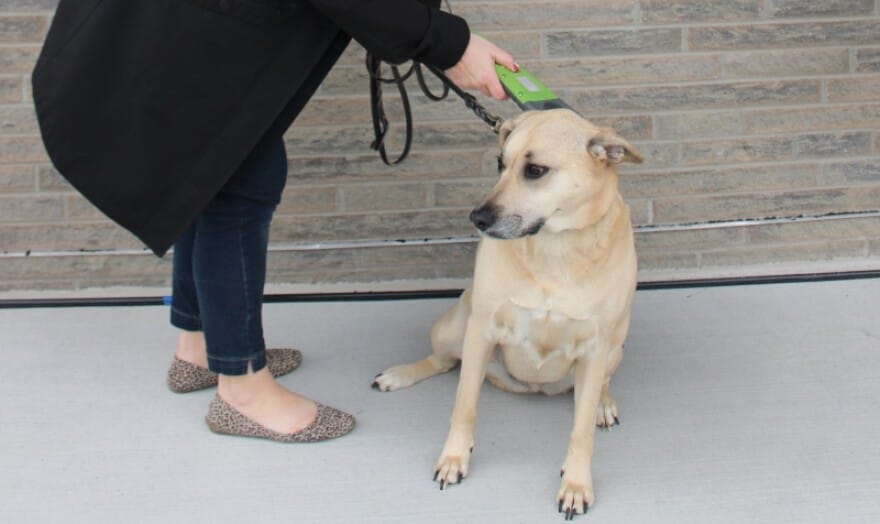
Chip Activation: When the scanner is passed over the animal’s implantation site (usually between the shoulder blades), the energy from the scanner’s electromagnetic field is captured by a tiny coil within the passive microchip. This process is known as inductive coupling.
Data Transmission: The captured energy briefly powers the chip’s internal circuit. The chip then transmits its unique ID code back to the scanner’s antenna as a coded radio signal.
B. Display and Interpretation
The scanner receives the coded signal and instantly decodes it, displaying the unique 15-digit identification number on the screen. This number is the single most important piece of information used for reunification.
C. Types of Scanners and Frequency Compatibility
The pet recovery system relies heavily on scanner compatibility.
Universal Scanners: The gold standard. These scanners are capable of reading all major microchip frequencies, including the standard $134.2 \text{kHz}$ (ISO) and the older $125 \text{kHz}$ (non-ISO) frequencies still found in some older pets or those chipped in North America before the ISO standard became dominant.
Non-Universal Scanners: Less desirable, as they can only read one specific frequency, potentially missing a pet chipped with a different standard. All veterinary offices and shelters should utilize universal scanners to maximize recovery success.
Technical Note: The ISO standard is crucial for international travel. If a pet chipped with a non-ISO chip is lost overseas, a non-universal scanner in the new country may not be able to detect it.
🗺️ The Critical Next Step: Database Registration
Finding the microchip number is only half the battle. The number itself is meaningless without an associated record. This is where the pet recovery database becomes the central pillar of the system.
A. The Registration Process
Once a pet is microchipped by a veterinarian or shelter, the owner must complete the vital registration step:
Data Submission: The owner submits the pet’s microchip number, their current contact information (phone, email, address), and the pet’s details (name, breed, color) to a specialized, secure national or international database.
Multiple Databases: In many regions, numerous private databases exist. It is paramount for owners to not only register but also keep their details current with the specific registry where their chip is recorded.
Global Lookup: Organizations like the AAHA Universal Microchip Lookup Tool (in the US) or similar centralized systems internationally are designed to search multiple participating registries simultaneously, directing the finder to the correct primary registry for the specific chip number.
B. The Lost Pet Protocol (Shelters and Vets)
When a lost animal arrives at a shelter or veterinary clinic, a standardized protocol is followed:
Immediate Scanning: The animal is thoroughly scanned immediately upon arrival. Personnel must scan the entire body, paying special attention to the neck and shoulder area, as chips can sometimes migrate slightly.
Database Search: The retrieved 15-digit number is entered into the universal lookup tool or directly into major local registries.
Owner Contact: If the chip is registered with up-to-date contact information, the finder can reach out directly to the owner, leading to a quick and happy reunion.
Warning: A staggering number of recovered pets have a microchip, but the owners’ contact information is outdated or missing. Owners must update their details every time they move or change their phone number.
🛡️ Beyond Dogs and Cats: Other Applications
While most commonly associated with companion animals, microchip scanners and the chips themselves have a wider array of applications critical to animal health and management:
A. Wildlife and Conservation
Chips are used to track and monitor populations of endangered or managed species.
Identification: Helps researchers track individual animals without intrusive tagging (e.g., in zoo populations or released animals).
Data Collection: Facilitates the recording of health, migration, and reproductive data over the lifespan of the animal.
B. Livestock and Equine Management
In commercial farming and horse racing, chips offer reliable, tamper-proof identification.
Traceability: Crucial for tracking the origin of food products (farm-to-table) and ensuring compliance with health and export regulations.
Medication History: Allows vets to instantly access a horse’s medical and vaccination records before administering treatment.
C. Automated Pet Doors and Feeders
Some specialized technology integrates chip-reading capabilities for domestic use.
Selective Access: Microchip-enabled pet doors only unlock for a pet with a recognized chip, preventing neighbor animals or wildlife from entering the home.
Portion Control: Specialized feeders can read the chip of a specific pet, ensuring it receives its prescribed diet and preventing food theft by other pets in a multi-pet household.
📈 Advancements and Future Developments in 2026

The technology, while already robust, continues to evolve to improve reliability and usability.
A. Temperature Sensing Chips
The newest generation of microchips incorporates a biothermal sensor.
Function: When scanned, these chips not only transmit the ID number but also provide an accurate reading of the pet’s body temperature.
Benefit: This is a non-invasive way to monitor an animal’s health, particularly useful during stressful situations or for tracking recovery from illness.
B. GPS and Active Tracking (A Common Misconception)
There is a frequent misunderstanding that microchips contain GPS.
Current Reality: Standard passive microchips do not contain GPS. They have no power source or transmission capability strong enough for real-time tracking.
The Future: Researchers are exploring ways to integrate low-power, short-range tracking technology, perhaps by harnessing kinetic energy, but a viable, affordable, and battery-free GPS microchip is not yet a widespread commercial reality in 2026.
C. Standardized Global Registries
The biggest improvement needed is not in the chip or the scanner, but in the data infrastructure. Efforts are underway to create more seamless, internationally recognized, and fully centralized databases to eliminate the current fragmentation and ensure every scan leads to an owner, regardless of the pet’s country of chipping.
In conclusion, the microchip scanner is more than a technological gadget; it is the vital bridge between a unique ID number and a heartbroken owner. Its effectiveness is maximized only when pet owners commit to two simple, crucial actions: implanting the chip and maintaining up-to-date registration details.